Insight
Word marks: a type of figurative marks in Thailand?
Trademarks can take a variety of shapes, colors or even sounds. The most basic ones remain “word marks”, which link products or services to a word, whether with a dictionary meaning or invented. Under Thai trademark practice, however, it seems that word marks are in many ways treated as figurative marks, creating unique challenges for applicants and practitioners.
Current practice for prosecution of word marks in Thailand
Pursuant to Section 7 of the Thai Trademark Act, a trademark may be a name, a word or a phrase, or an invented word, and are distinct from stylized characters (letters or numerals) or invented device.
When an application is filed through the e-filing system, the applicant or their agent must upload an image file for all marks, including word marks. This requirement means that for word marks, a specific font must be chosen by the applicant to prepare the trademark specimen. In the database and Certificate of Registration, the mark will be displayed exactly as per the specimen filed.
Applicants must be particularly careful when filing a trademark application with a priority claim. The Thai Department of Intellectual Property (DIP)’s Trademark Examination Guidelines state that when an applicant claims priority from a foreign application, the trademark specimen filed in Thailand must be identical to the one in the priority application, including the font used for word marks.
As a consequence, a priority claim will be rejected if the word mark is filed in Thailand using a different font. The application itself will, however, remain valid despite the rejected priority claim.
Open questions: uncharted territory for word marks in Thai trademark practice
First unsettled issue: evidence of use for word marks
When a trademark is rejected on grounds of lack of distinctive character, and if it is already being used in Thailand, the applicant may file an appeal against the rejection arguing that their mark has acquired distinctiveness through use. This means that due to extensive use and marketing of the mark, despite its arguably descriptive character, Thai consumers will associate the mark with the products or services of the applicant. To demonstrate this point, the applicant must provide evidence of use of their mark in Thailand.
It remains unclear whether, for word marks, such evidence of use would be deemed inadmissible if the mark is displayed in a different font than the one used in the application form, particularly in marketing materials or when used on products. Previous decisions from the Trademark Board have rejected evidence of use where the mark, filed as a word, was used in combination with a device element or with different stylization (e.g., lowercase letters instead of uppercase letters):
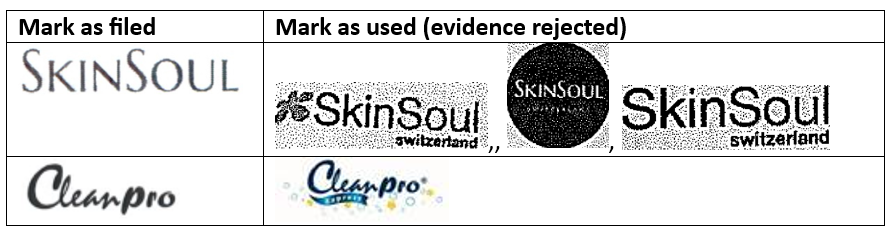
One could reasonably assume, however, that in cancellation proceedings for non-use, the Trademark Board would accept such evidence, considering the relatively low threshold imposed on the trademark owner to demonstrate actual use of the mark in Thailand in such procedures.
Second unsettled issue: word marks filed via the Madrid system
An increasing number of jurisdictions worldwide facilitate applications for plain word marks, which do not need to be presented as image file. On their national databases, plain word marks will then be allocated a default font.
These national applications constitute the basis for international registration, and the office of origin must certify that the details of the Madrid application are identical to those of the national basic application.
Further, when filing the Madrid application, applicants have the option to include a declaration stating that their mark should be considered as “a mark in standard character”. However, a visual representation of the mark must be furnished with the international application. This visual representation will be the one used and uploaded by the Thai Department of Intellectual Property in their database.
According to WIPO practice, contracting parties are not bound to consider the above-mentioned declaration. In addition, further to dialogue with the Thai DIP, it appears that this declaration will have no effects in Thailand, even though it can be included in Madrid applications filed via the Thai DIP as office of origin.
Therefore, one could assume that proving distinctiveness through use for word marks filed via the Madrid Protocol will encounter the same obstacles as word marks in domestic applications.
Conclusion and advice
The treatment of word marks as image-dependent specimens in Thailand creates a unique landscape where traditional word mark flexibility is constrained by font selection. This approach fundamentally alters the nature of word mark protection, effectively treating such marks more like figurative marks than the text-based rights typically associated with word marks in other jurisdictions.
As long as word marks must be filed as image files, applicants should always choose a specimen displaying the trademark in the font most commonly used in their commercial activities, particularly if evidence of use may need to be provided later. This practical consideration becomes even more critical given the uncertain parameters for acceptable evidence of use and the potential implications for both prosecution and enforcement strategies.
The convergence of domestic filing requirements and Madrid Protocol procedures further compounds these challenges, suggesting that fundamental reforms to Thailand’s word mark registration system may be necessary to align with international best practices and provide clearer guidance for trademark practitioners.
References:
[1] Trademark Act B.E. 2534 (1991).
[2] Manual for the Consideration of Trademark Registration, B.E. 2565 (2022).
[3] Trademark Board, decisions nos. 2119/2566 and 473/2563.
[4] Ministerial Regulation B.E. 2560 Trademark Registration under the Madrid Protocol.
[5] Madrid Agreement Concerning the International Registration of Marks (as amended on September 28, 1979).
[6] Administrative Instructions for the Application of the Protocol Relating to the Madrid Agreement Concerning the International Registration of Marks (as in force on February 1, 2023).
[7] Regulations under the Protocol Relating to the Madrid Agreement Concerning the International Registration of Marks (as in force on November 1, 2024).