InsightS
Divergent interpretation on trademarking a sequence of letters or numerals in Thailand
Pursuant to Section 7 of the Thai Trademark Act, a mark may consist of a photograph, drawing, invented device, logo, name, word, phrase, letter, numeral, signature, combination of colors, figurative element, sound, or any combination thereof. Under Section 6, a mark must also be distinctive, meaning it must enable the public to distinguish the goods or services with which it is used from those of others.
Each type of mark is subject to specific requirements based on its category. For instance, a mark consisting of a word or phrase must not directly reference the character or quality of the goods for which it is applied, nor should it be a geographical name. Similarly, a combination of colors must be represented in a special manner to be considered distinctive.
Regulations and judicial precedent regarding distinctiveness criteria for alphabetic and numeric marks
Character stylization requirements
Letters, numerals, or a sequence thereof, including acronyms, are subject to the requirement of being stylized. However, the Trademark Act provides no definition for “stylization” or “stylized letter/numeral”. Therefore, it is useful to examine The Thai Department of Intellectual Property (DIP)’s Trademark Examination Guidelines to gain further insight. According to these Guidelines published in 2022, a stylized sequence of characters is characterized by any of the following features:
– Intertwined or overlapping characters,
– Thickness and depth,
– Patterned designs, such as a checkerboard pattern, or
– Layered effects to create shadow.
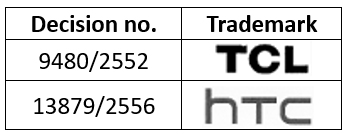
In Decision No. 9480/2552, the Court found that the acronym trademark “TCL” filed in plain text was inherently distinctive. The Court ruled that a sequence of three Roman letters arranged in no particular order renders the mark “stylized” under the law.
The Supreme Court maintained this legal reasoning in Decision No. 13879/2556, finding that the uppercase Roman letters “HTC” were combined in a manner distinct from ordinary letters. This enabled the public and consumers to associate the goods bearing this trademark with their owner and distinguish it from other trademarks.
Reluctance of the registrar and the Trademark Board to adhere to the Supreme Court’s rulings
A significant problem arises from a direct conflict within the DIP itself. While the DIP’s own Trademark Examination Guidelines align with the Supreme Court’s precedent, in practice, the DIP registrar and the Trademark Board often fail to follow these very guidelines.
This is evidenced by a series of Board decisions that consistently uphold the registrar’s rejections, as illustrated below:
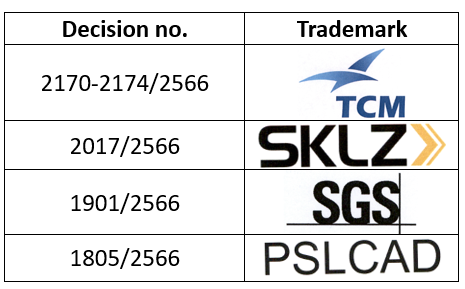
All the Board’s decisions above reiterated that a random arrangement or sequence of plain letters or numerals cannot be considered a form of stylization, regardless of the number of characters. This view is based on a strict interpretation of the law, insisting that since the provisions clearly specify “stylized” letters or numerals, it cannot be interpreted otherwise. Following this reasoning, treating an arrangement of non-stylized letters as a stylized mark would improperly expand the provisions of the law.
This refusal to adhere to the guidelines reveals a fundamental schism in legal interpretation. The Board and registrars have consistently held a stricter standpoint than the Supreme Court.
It is noteworthy that in the Board’s Decisions Nos. 2170-2174/2566, even though the appellant based its argument on the DIP’s Trademark Examination Guidelines acceptance of a random sequence as a form of stylization, the Board dismissed the appeal holding that it was not bound to decide the case based on these regulations and retained full authority to review both factual and legal aspects independently. This position directly contradicts established Supreme Court precedent recognizing sequences of three or more characters as inherently distinctive.
Conclusion
The conflict between the DIP’s own Guidelines and their practical application by registrars and the Trademark Board represents a critical systemic issue in Thai trademark law. While both the DIP’s Guidelines and Supreme Court jurisprudence have adopted progressive, applicant-friendly interpretations of the need for “stylization” for plain characters, the Trademark Board’s adherence to a strict literalist approach creates profound and unresolved inconsistency. This underscores the urgent need for greater clarity and consistency in trademark examination practices.
References:
[1] Trademark Examination Manual of the Department of Intellectual Property, B.E. 2565 (2022).
[2] TCL Technology Group Corporation v. Department of Intellectual Property, Case No. 9480/2552 (2009).
[3] HTC Corporation v. Department of Intellectual Property, Case No. 13879/2556 (2013).
[4] Trademark Board Decisions No. 2170/2566 (2023), No. 2104/2566 (2023), No. 2017/2566 (2023), No. 1901/2566 (2023), No. 1805/2566 (2023).