TMP Tips
Common grounds for refusal of trademark applications in Thailand
Once the trademark applications have been duly filed with the Thai Department of Intellectual Property (DIP), they will be examined by the trademark registrar to determine whether they comply with the applicable laws and established practices in Thailand. Each application is assigned to a specific registrar, typically based on the classification of the goods or services covered by the application, or in some cases, the name of the applicant. Consequently, the timeframe for examination may vary depending on the workload and discretion of the assigned registrar.
In practice, it generally takes approximately six months to one year from the filing date for the registrar to issue the first office action. Such action may take the form of an acceptance for publication or a refusal. If the registrar determines that the application satisfies all legal requirements for registration, the trademark will proceed to publication in the official Trademark Gazette for a period of sixty days. During this period, any interested party may file an opposition. If no opposition is filed, the application will proceed to registration.
On the other hand, if the registrar determines that the application does not meet the relevant requirements, an office action rejecting the trademark will be issued, requesting amendments or raising substantive grounds of refusals. The applicant will have sixty days to respond. Failure to respond within the prescribed timeframe will result in the application being deemed abandoned. Common grounds for refusal or trademark rejection in Thailand are further analyzed in this article.
1. Broad or unclear specification of goods and/or services
Unlike most jurisdictions that adopt the Nice Classification for both classification and specification of goods and services, in Thailand, the DIP has established its own standards for the specification of goods and services. While the classification of goods and services remains consistent with the Nice Classification and its successive updates, the specification must be clearly defined and must not be expressed in overly broad or vague terms.
Applicants may select items from the DIP’s pre-approved list of goods and services, available at https://tmsearch.ipthailand.go.th/, to minimize the risk of objections or amendment orders. Nevertheless, the registrar may also consider and accept specifications that are not included in the pre-approved list, provided that such specifications are sufficiently precise, clearly defined, and consistent with or narrower than those appearing in the pre-approved list.
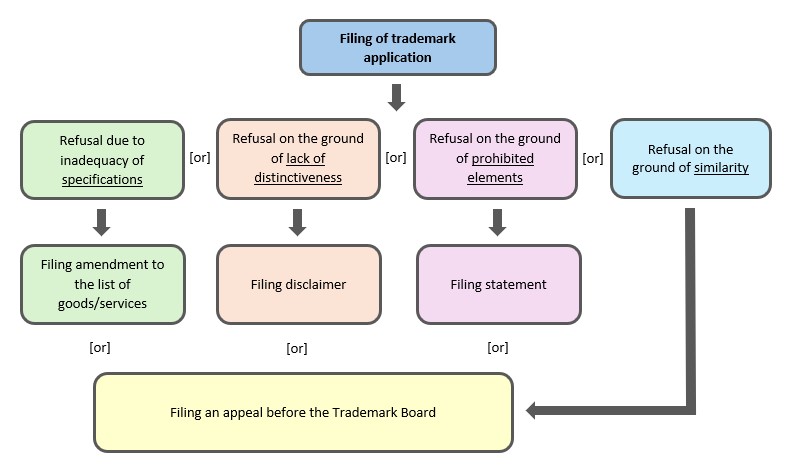
If a trademark application is rejected on the grounds of an overly broad or unclear specification, the applicant will be required to file an amendment to the list of goods and/or services using the Kor.06 form (amendment form). There will be an official fee of THB 200 to amend the application. Following submission, the registrar will review the amendment, which typically takes approximately three to six months, depending on the registrar in charge and the complexity of the amendment. In practice, amendments involving only a limited number of items may be processed more expeditiously. If the application that has been amended is a Madrid application, the timeframe for the review of the amendment will be one to two years.
Once the amended list of goods and/or services is accepted, the application will proceed to publication. However, if the specification is still considered overly broad or insufficiently precise, the registrar may issue further office actions requesting additional amendments.
In the event that the applicant does not agree with the registrar’s requirement to amend the specification, the applicant is entitled to file an appeal with the Trademark Board. The official fee for filing such an appeal is THB 2,000.
Examples of specifications that are considered too broad and common alternatives:
Class | Acceptable under Nice Classification | Acceptable under Thai DIP Practice |
3 | Cosmetics |
|
9 | Computer hardware |
|
25 | Clothing |
|
35 | Administration services relating to business transactions and financial records, for example, book-keeping, drawing up of statements of accounts, business and financial auditing, business appraisals, tax preparation and filing services |
|
2. Lack of distinctiveness
Pursuant to Sections 6 and 7 of the Thai Trademark Act B.E. 2534 (1991), a registrable trademark must possess distinctiveness. In other words, the mark must be capable of enabling the public or relevant consumers to distinguish the goods or services to which the mark is applied from those of others.
Section 7, paragraph two, of the Act further provides examples of characteristics that are deemed to be distinctive. These include, for instance, a word or phrase that does not directly refer to the characteristics, or quality of the goods or services and is not a geographical name prescribed by the Minister, as well as invented or coined words, stylized letters, numerals, or devices. Such elements are generally considered capable of distinguishing the applicant’s goods or services from those of others.
In practice, one of the most common absolute grounds for trademark rejection raised by the registrar is that the applied-for mark is descriptive or generic. A trademark that directly describes the characteristics and qualities of the relevant goods or services will typically be considered non-distinctive and, therefore, unregistrable. The assessment of distinctiveness is subject to the discretion of the registrar, who will consider the overall impression of the mark in relation to the specified goods or services.
Furthermore, combinations of descriptive words that collectively convey a direct reference to the characteristics or qualities of the goods or services will generally not be regarded as distinctive. Likewise, mere misspellings or minor variations of descriptive terms are unlikely to be accepted as coined or invented words.
Lack of distinctiveness of a trademark or some elements appearing in a trademark may lead to two different types of refusal, explained hereafter.
2.1 Rejection of the trademark application
If a trademark is considered entirely non-distinctive, namely where its essential elements lack distinctiveness, the application will be rejected. In such circumstances, the applicant is entitled to file an appeal before the Trademark Board against the registrar’s decision by submitting the Kor.03 form (appeal form), which is subject to an official fee of THB 4,000.
Where there are reasonable grounds to argue that the mark should not be regarded as non-distinctive, for example, where the decision has been taken arbitrarily, or where the non-distinctive element is capable of being disclaimed, filing an appeal is advisable, as the registrar’s decision may be overturned by the Trademark Board.
In addition, where the trademark has been used in Thailand and the applicant is able to provide evidence of continuous use for at least three years, and preferably five years, the applicant may argue in the appeal that the trademark has acquired distinctiveness through use, even if the mark is inherently non-distinctive. Such evidence may include, for example, invoices, receipts, and purchase orders, as well as records of events or promotional activities featuring the mark, demonstrating that the relevant goods or services have been marketed and made available in Thailand, and is now widely recognized by the Thai consumers.
If the trademark is indeed non-distinctive and has not been used in Thailand, it may be more practical to file a new trademark application. Indeed, the appeal process typically takes at least four years up to the issuance of a decision. In such cases, the applicant may consider adopting a more distinctive mark, for example, by incorporating a distinctive device element or additional word(s) displayed in a size larger than, or at least equal to, the non-distinctive term, and disclaiming any non-distinctive components.
2.2 Request for filing a disclaimer
Where a trademark, when considered as a whole, is registrable but contains one or more elements that are descriptive or generic in relation to the goods or services covered by the application, the registrar may require the applicant to record a disclaimer in respect of such elements. No official fee is charged for recording a disclaimer.
The consequence of such disclaimer statement would be that the applicant will not be able to claim exclusive rights to use the portion of the mark that has been disclaimed but the mark in its entirety would still be protected.
If the applicant does not agree with the registrar’s requirement to enter a disclaimer, the applicant may file an appeal with the Trademark Board to contest such requirement.
For instance, for the service mark “TMP Intellectual Property” registered for legal services, the words “Intellectual Property” need to be disclaimed, as they make a direct reference to the services provided under the mark.
3. Prohibited marks under the Trademark Act
A registrable trademark must not contain or consist of any prohibited elements as prescribed under Sections 6 and 8 of the Trademark Act. Such prohibited elements and absolute grounds for rejection include, but are not limited to, the following:
national flags of Thailand, royal standard flags, or official flags;
official emblems and emblems of the Red Cross;
any mark that is contrary to public order, morality, or public policy; and
any mark that is identical or similar to a well-known mark.
In cases where a logo is filed in black and white and incorporates stripe patterns resembling those of the national flag or including a “+” sign, the registrar may require the applicant to submit a statement regarding the use of the trademark. The statements, akin to disclaimers, may be phrased as follows:
“I hereby certify that the stripes will not be used in a manner identical to or resembling the colors of the national flag or any similar colors”; or
“I hereby certify that the symbol ‘+’ will not be used as a red or green cross on a white or silver background, nor as a white or silver cross on a red background”.
A trademark application that incorporates the (R) (registered) symbol will be considered contrary to public order, morality, or public policy, as such symbol is permitted for use only upon registration. For domestic applications, the registrar will normally allow the applicant to delete the symbol from their logo.
With respect to well-known marks, the definition or criteria for determining what constitutes a well-known mark are not clearly specified under the Thai Trademark Act. Therefore, reference may be made to the definition under the TRIPS Agreement, to which Thailand is a party, whereby a mark is considered well-known based on its level of recognition among the relevant sector of the public.
Where a trademark is deemed to consist of or contain a prohibited element under the Trademark Act, and filing of one of the above-mentioned statements or adjusting the logo would not be sufficient, the applicant must file an appeal against the refusal before the Trademark Board.
4. Identical or similar to prior filed or registered trademarks
A trademark application may be rejected on relative grounds if it is considered identical or similar to a registered trademark or a prior pending trademark application. In practice, when assessing similarity, the registrar will examine the mark as a whole, taking into account its visual appearance, pronunciation, as well as the nature of the goods or services covered.
Where a trademark application is found to be identical or similar to a trademark that is already registered, the applicant may file an appeal against the refusal before the Trademark Board. However, if the application is considered identical or similar to a prior pending trademark application, the examination of the later-filed application will typically be suspended until the cited application proceeds to publication, registration, or lapses. Once the cited trademark application is published, the applicant of the later-filed mark is entitled to file an opposition against the cited application within the prescribed period (60 days). Alternatively, if the cited trademark proceeds to registration, the applicant must file an appeal within 60 days from the date of receipt of the notification of such registration. Failure to submit the appeal within the stipulated period will result in the application being deemed abandoned.
On the other hand, if the cited trademark application is abandoned, the refusal on the ground of similarity will be withdrawn.
It should also be noted that a trademark application may be rejected on the grounds of similarity with another mark owned by the same applicant. This situation may arise, for example, where the Thai transliteration or translation of the applicant’s name differs between applications, leading the registrar to treat them as separate entities. In such cases, an amendment to standardize the Thai name of the applicant is generally sufficient to overcome the refusal.
Furthermore, in cases where the applicants of the cited and conflicting marks are related entities, such as affiliated companies within the same corporate group, a letter of consent is not accepted under Thai trademark practice and is insufficient to overcome the refusal based on similarity. To resolve such an objection, the applications must be consolidated under the same applicant by recording an assignment of the cited trademark or the objected trademark application so that both marks are held in the name of a single entity.
Conclusion
Trademark applications filed in Thailand are examined by the registrar to determine whether they meet the requirements for registration under the Thai Trademark Act and the established practice of the DIP. Where office actions are issued on various grounds, different approaches may be required to respond appropriately within the prescribed deadline.
An application will not be immediately rejected upon the finding that it does not meet the registrability requirements. Instead, the applicant is generally given an opportunity to remedy any deficiencies identified by the registrar. This may involve amendments to the specification of goods and/or services, the submission of disclaimers or statements, or the filing of an appeal before the Trademark Board for reconsideration.
It is important to note that strict compliance with the prescribed time limits is essential, as failure to respond or to file a response within the required period may result in the application being deemed abandoned.
Trademark application examination – Decision flowchart
References:
[1] Department of Intellectual Property