News
Situation update on provisional refusals in Thailand
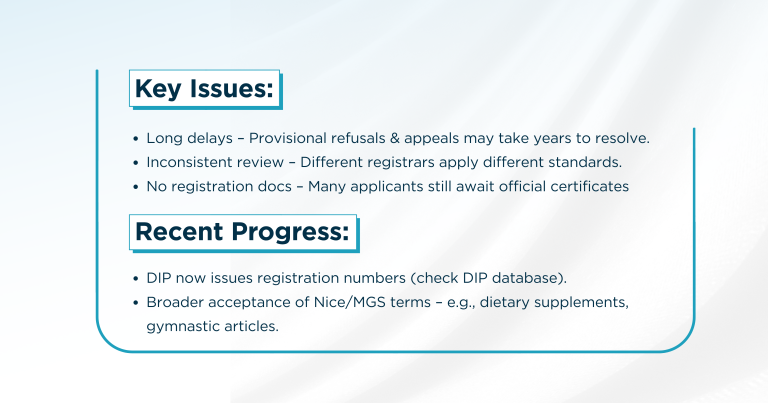
The implementation of the Madrid Protocol in Thailand remains, to date, an unfinished business. Very few Madrid applications designating Thailand have been registered without the applicants having to jump through hoops and loops, particularly dealing with provisional refusals, in order to reach the end of the process. Almost seven years after the Madrid System became operational in Thailand, significant gaps remain, but noticeable progress has been made to smoothen up the procedure – lets’ take stock.
Implementation flaws of the Madrid Protocol in Thailand
1- Long processing time
In terms of implementation flaws, a few should be mentioned, starting by the long processing time until the issuance of a provisional refusal or the publication of the application.
Once a provisional refusal is issued on the basis of the list of goods and services, it will take a minima another year (and up to two years) for the registrar to consider the amendment of the list. Which means that, by the time it is considered, the examination criteria may have changed, leading to the issuance of a second provisional refusal.
If the application is rejected on the basis of lack of distinctiveness or similarity to prior marks, an appeal should be filed before the Trademark Board, with current processing time of 4 to 5 years.
2- Lack of streamlined review
Unfortunately, there is still a notable lack of harmonization for reviewing the list of goods and services among registrars, each registrar applying their own standards. This means that two trademarks having the exact same list of goods and services, examined by different registrars, will receive provisional refusals listing different items.
To limit the risks of receiving any provisional refusals at all, applicants may consider using items listed on the Thai DIP’s pre-approved official bilingual list of goods and services, available at the following link: https://tmsearch.ipthailand.go.th/ (keyword search).
3- Lack of synchronization with WIPO’s database
The Thai DIP database and WIPO Madrid Monitor are not well synchronized. After a provisional refusal has been issued, applicants can no longer follow the status on their application on WIPO’s database. It will not be updated once the application is published and then registered in Thailand (or it may take years).
Similarly, the Thai DIP database does not reflect changes on WIPO Madrid Monitor as they occur. Changes in names, addresses or assignments will be recorded with several months of delay. In addition, the renewal deadlines that appear of the Thai DIP database for Madrid applications are inputted based on domestic applications. This leads to incorrect renewal deadlines, in particular when Thailand was a subsequent designation under the Madrid Protocol.
4- No registration documents in sight
Applicants having filed an international registration designating Thailand as early as 2017 are still awaiting the issuance of an official document from the Thai Department of Intellectual Property stating that their trademark has been registered in Thailand, whether a statement of grant of protection or a traditional Certificate of Registration.
There has been no official communication from the Thai DIP regarding how this will be delt with, although WIPO’s Madrid Member Profile regarding Thailand indicates that:
– The Thai DIP will communicate the granting of protection to WIPO by sending a separate document for each international registration; and
– If a local representative has been appointed, the Thai DIP will “issue the certificate of registration and send to the local representative by post”.[1]
Advancements in the implementation of the Madrid Protocol in Thailand
There has been noticeable progress in the examination of Madrid applications designating Thailand. First, the Thai DIP started issuing registration numbers for applications whose examination has been completed in the end of 2022. These numbers can only be obtained by checking the Thai DIP’s database.
In addition, the Thai DIP has been broadening the list of acceptable items derived from the Nice Classification and the Madrid Goods & Services Manager (MGS). While some classic “class-heading-type” items such as “cosmetics”, “pharmaceuticals”, “computer hardware”, “jewelry”, “stationery” or “clothing” are still rejected, the Thai DIP now accepts items such as “dietary supplements for human beings and animals”, “gymnastic articles” or the lengthy “the bringing together, for the benefit of others, of a variety of goods, excluding the transport thereof, enabling customers to conveniently view and purchase those goods” which used to be deemed too vague in the recent past.
Further progress has been impended by the pandemic crisis from 2020 to 2022, where many meetings were postponed, and the ongoing maintenance and overhaul of the DIP’s database and e-filing system, which also had consequences on the timely examination of domestic applications.
Written by: Adele Marchal
Reviewers: Munif Chaipanya
References:
[1] WIPO’s Madrid Member Profiles: https://www.wipo.int/madrid/memberprofiles/selectmember
Related Attorneys

ADELE MARCHAL
PARTNER