News
Cancellation of an illegally registered trademark
An analysis of the Xiaoxiong (小熊) case
Under Thai law, in order for a trademark to be registered in Thailand, the mark must be distinctive, must not be prohibited under the Thai Trademark Act, and must not be identical or similar to a trademark registered by another person, as prescribed in Section 6 of the Trademark Act B.E. 2534 (1991). The registered trademark may subsequently be cancelled upon the initiative of the owner, a third party, or by the Registrar, in accordance with Part 4 of the Trademark Act B.E. 2534 (1991).
Where the cancellation is initiated by a person other than the owner, the trademark may be cancelled on the grounds that it did not meet the requirements of the Trademark Act at the time of registration or that it has subsequently become unregistrable after registration. This article focuses on the cancellation of a trademark that should have been deemed unregistrable at the time of registration.
Facts of the case
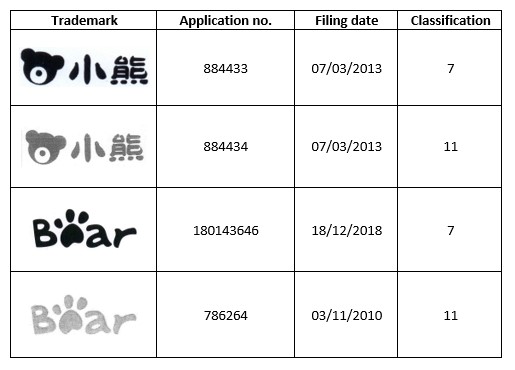
The cancellation petitioner, Bear Electric Appliance Co., Ltd., an entity incorporated in China, registered the following trademark with the Chinese characters “小熊” (Xiaoxiong) in several countries, and in Thailand since 2013:
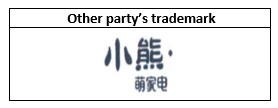
In 2020, the other party filed two trademark applications containing the Chinese characters “小熊” for goods similar to those of the petitioner in classes 7 and 11:
Despite the similarity between the petitioner’s trademark and those of the other party, the latter were examined by the Registrar and subsequently registered in 2023.
Once made aware of the situation, in 2025, the petitioner filed cancellation petitions against the other party’s trademarks on the following grounds:
1) At the time of registration, the other party’s trademarks were so similar to the petitioner’s trademark that they were likely to confuse or mislead the public as to the ownership or origin of goods in the same class and of the same nature.[1]
2) The other party’s trademarks contained prohibited characteristics under Section 8 of the Trademark Act, as they were similar to well-known trademarks[2] and were contrary to public order, good morals, or public policy.[3][4]
The other party did not file a counterstatement during the statutory 60-day period.[5] Accordingly, the Trademark Board considered the matter and rendered its decision on an ex parte basis.
Decision of the Trademark Board
Upon consideration of the cancellation petitions, the Trademark Board analyzed the grounds for its decision under four issues, as summarized below:
1) The petitioner is an interested person
According to Section 61, a person who is entitled to initiate a cancellation petition must be an “interested person”. The Trademark Board considered that the petitioner had registered trademarks incorporating the Chinese characters “小熊” in Classes 7 and 11 in several countries, including Thailand, prior to the registration of the other party’s trademarks. The registration of the other party’s trademarks therefore infringed the petitioner’s rights to use its trademarks. Accordingly, the petitioner was considered an interested person and was entitled to file the cancellation petitions.
2) The other party’s trademarks were so similar to the petitioner’s prior registered trademarks at the time of registration

The Trademark Board considered that the essential element of the other party’s trademarks consisted of the Chinese characters “小熊”, which are identical to those in the petitioner’s trademark and are designed in an identical manner. This resulted in similarity in both appearance and pronunciation. Furthermore, the trademarks were registered for goods in the same classes and of a related nature, namely household electrical appliances. Therefore, the other party’s trademarks were likely to cause confusion or mislead the public as to the ownership or origin of the goods and were considered similar to the petitioner’s registered trademark at the time of registration.
3) The other party’s trademarks contained prohibited characteristics at the time of registration and were contrary to public order, good morals, or public policy
After considering the evidence of use and registration of the petitioner’s trademarks in Thailand and other countries, the Trademark Board found that these trademarks were registered prior to the registration of the other party’s trademarks. The Board further considered that it is unlikely that different persons in different places would independently create highly similar trademarks and use them for similar goods.
Furthermore, according to the Department of Intellectual Property (DIP) database, it was found that the other party initially filed the trademark incorporating the stylized “Bear” word of the petitioner’s other marks and subsequently removed this element in order to overcome the refusal based on similarity to the petitioner’s trademark application number 180143646. In addition, upon receipt of the cancellation petitions, the other party negligently failed to file a counterstatement.
These circumstances supported the belief that the other party did not act in good faith in registering the trademarks but instead distorted the petitioner’s trademarks with the intention of gaining unfair commercial advantage. Such conduct is considered contrary to public order, good morals, or public policy, which is prohibited under Section 8(9), Section 61(2), and Section 62 of the Trademark Act.
As a result, the Trademark Board decided to cancel the registrations of trademark application nos. 200107300 and 200107301.[6] The Board did not consider whether the petitioner’s trademarks qualified as well-known trademarks, as such a determination would not have affected the outcome of the decision.
The other party was entitled to file an appeal before the Central Intellectual Property and International Trade Court within 90 days from the date of receipt of the cancellation decision. However, no appeal was filed within the prescribed period. Accordingly, the trademarks are now deemed abandoned.
Conclusion
A trademark that infringes prior trademark rights may still be cancelled even after it has been registered. Under Thai trademark law, registration does not grant absolute protection where the mark was unregistrable at the time of registration, particularly when it is identical or confusingly similar to a prior registered trademark for the same or related goods. In such circumstances, the owner of the earlier trademark, as an interested person, is entitled to file a cancellation petition to protect their rights. Accordingly, trademark registration obtained in violation of the rights of prior trademark owners may later be revoked through cancellation proceedings.
References:
[1] Section 61 (4) of the Trademark Act B.E. 2534 (1991)
[2] Section 8 (10) of the Trademark Act B.E. 2534 (1991)
[3] Section 8 (9) of the Trademark Act B.E. 2534 (1991)
[4] Section 62 of the Trademark Act B.E. 2534 (1991)
[5] Section 64 of the Trademark Act B.E. 2534 (1991)
[6] Trademark Board decision no. 94-95/2568