InsightS
Customs recordal in Thailand:
an essential initial step for effective IPR enforcement
The Thai Customs Department introduced its platform for intellectual property recordation, the Thai Customs IPR Recordation System (TCIRs), in July 2022. Through this platform, intellectual property owners and their authorized representatives can initiate new customs recordals, update record details and request the renewal of their past recordals.
Customs recordal is a critical first step in starting the enforcement process in Thailand. It not only prompts customs authorities to monitor specific brands and products but also strengthens their relationship with the brand representative and leads to more customs seizures. This proactive approach encourages customs authorities to take action against infringing and counterfeit goods that are imported, exported, or in transit through Thailand.
While it is an essential part of enforcement strategy for brand owners and follows a straight-forward procedure, customs recordal in itself is not sufficient for preventing IPR infringements in Thailand. Thus, to be effective, it should be combined with other complementary enforcement measures.
Procedure basics: documents required, validity of recordation and timeline
With the use of the TCIRs website, the process has been simplified. For a new recordal, the following documents are required:
(1) A notarized Power of Attorney (POA);
(2) A recent copy of the IP rights owner’s company registration certificate;
(3) A copy of either the trademark Certificate of Registration or the copyright notice issued by the Thai Department of Intellectual Property (DIP);
(4) Optional or upon request: guidelines to help officers distinguish genuine and counterfeit products, to be submitted as hard copy.
To initiate the process, the required documents and the application must be filed on the Thai Customs platform. Following this, hard copies of all documents, including the application, should be submitted in person with the Thai Customs. The Thai Customs will then review and approve the application within a couple of days.
The recordation remains valid for 3 years from the date of recordation, or until the end of the protection term of the rights (if shorter). It can be renewed no later than 30 days prior to the expiry date. Any updates in the information provided must be submitted with the renewal request.
In addition, for the recordal to remain valid, a new POA or trademark registration certificate must be submitted through the TCIRs website whenever the document previously filed expires, this within 30 days of their expiration date. If the up-to-date documents cannot be provided, a letter of explanation should be provided to Thai Customs to ensure that the recordal will remain active.
Unlocked potential of the new customs recordal system
Customs officers can access and utilize the information recorded in the database to verify the authenticity of goods imported, exported, or transiting through the country. The access to the TCIRs is strictly regulated and restricted to authorized customs officials only, this to prevent information disclosure. However, brand owners remain reticent to provide sensitive information on identification of counterfeit products through electronic means. The guidelines that are available in the system may thus be of limited help for custom officers.
The new platform allows for the recordation of the contact details of the brand owners’ local representatives’, which customs officers may use when in need of their cooperation in the impounding process. Other enforcement authorities may still be reaching out to the representatives on record on the Thai DIP trademark and copyright database. Customs authorities and the Thai police may also use the DIP database accessible only to them for finding the brands’ local enforcement agents.
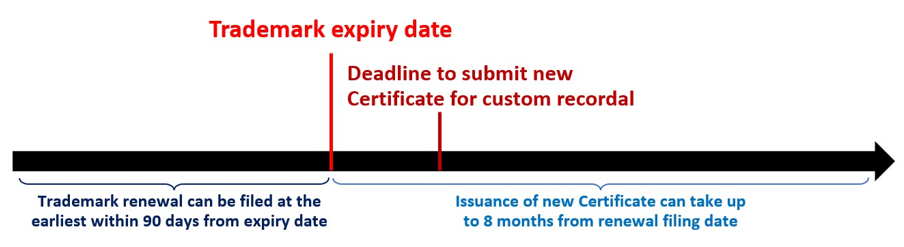
The main stumbling block of the customs recordal in Thailand is the timeline to renew the recordation for trademark rights. A trademark must be renewed every 10 years, within the 3-month window before its expiry date, at which point the Thai DIP issues a new Certificate of trademark Registration. When the same agent handles the renewal, the process is efficient and can even be completed within a single day. However, if the trademark’s representative changes, renewal can take up to 8 months before the new Certificate is issued. Because the TCIRs mandate submission of the updated certificate within 30 days of expiration, this delay risks missing the deadline. In such cases, the agent may need to submit a letter to the DIP requesting expedited processing and send an explanatory letter to Thai Customs. A worthwhile improvement would be to align the TCIRs’ 30-day submission requirement with the actual timeline for issuing the renewed Certificate.
Necessary complementary enforcement approaches
Without clear guidance from IPR owners to distinguish genuine products from counterfeits, customs officers face challenges in using the TCIRs effectively. To address this, IPR owners should complement recordal with targeted enforcement support, especially training, at key points of entry.
The most effective complementary strategy is organizing hands‑on training sessions for enforcement authorities at designated border checkpoints. These sessions not only familiarize officers with a brand’s authentic products and distinctive markers, but also equip them with practical tips for identifying counterfeits. IPR owners (or their local representatives) should coordinate directly with the Thai Customs Department to schedule such trainings, as Customs itself does not run these events. When conducted in Bangkok, multiple agencies may be invited beside Customs, such as the Department of Special Investigation (DSI), the Economic Crime Division (ECD), and the Consumer Protection Police Division (CPPD).
During training, rights holders can showcase real and counterfeit product samples and share key distinguishing features, such as trademark placement, material quality, or packaging details, which helps officers to spot fakes more reliably. Moreover, these sessions foster vital relationships between IPR owners and their representatives, customs officers and other governmental enforcement bodies, enabling faster verification, cooperation, and escalation when suspected goods are intercepted.
For customs recordals or organization of training with enforcement authorities, please contact us at contact@tmp-ip.com.