Design basics
Starting with the basics: a definition of design
What is a design?
A design is a legal right protecting the visual appearance of a product, including its shape, pattern elements, or the composition of lines and colors, which constitute the essential visible features of a product.
What types of products can be protected by a patent for design?
A design can only be granted for handicraft products or products that are industrially applicable and have primarily a functional purpose, as opposed to copyright for artworks. In specific cases, copyright and design may be granted for the same product, in particular in the case of applied art.
What is excluded from design protection?
Design protection does not extend to the function of the invention. Specifically, the functional purpose, structure, mechanism, or operational processes of an invention are protected by invention patents.
Design protection does also not cover trademarks, which should normally be removed from all drawings provided in a design application, or disclaimed.
Finally, artworks are mainly protected by copyright. Only applied art (when the artwork also has a functional purpose) may be protected by copyright and design.
Before filing a design application: preparing information, documents and budget
Maintaining the novelty of a design
Design patents can only be granted to “new” designs. The criteria for considering whether a design is new are as follows:
– The design must not have been used or widely known in Thailand before the Thai filing date.
– The design must not have been disclosed in any documents or publications, whether in Thailand or a foreign country.
– The design must not have been published in Thailand or any foreign country before the Thai filing date.
– The design must not be similar to any published/known design to the extent that it could be considered an imitation.
Based on the Paris Convention for the Protection of Intellectual Property, of which Thailand is a member, a person who applied for a design application in a jurisdiction covered by the Convention may apply for a design for the same product within 6 months from the first filing date. This “priority claim” will have the double benefits of preserving the novelty of the product in this 6-month period and of keeping the first filing date of the patent application as the filing date in subsequent jurisdictions.
Information regarding the designer(s) and the applicant(s)
The owner of a design patent may be either an individual or a legal entity. The designer(s) may therefore apply to be the owner of the patent for their invention, or decide to assign this right to another person or a legal entity.
When applying for a design patent, information regarding the designer(s) and applicant(s) must be provided, including their name, address and nationality or country of incorporation.
Documents required to file a design application
The formal documents required vary:
– Foreign applicants must appoint a local representative to file the application on their behalf in Thailand, while Thai companies or Thai nationals or residents may file the application themselves. When foreign applicants appoint a local representative, a notarized Power of Attorney is always required.
– If the design application is filed for an individual, a statement of the applicant’s rights must be submitted.
– If the design application is filed for a legal entity, a Deed of Assignment from the designer(s) to the legal entity must be submitted.
– If the application is filed with a priority claim under the Paris Convention, a certified copy of the priority application must be provided.
Beside the formal documents, the design application must include a title and a short description of the design. Requirements regarding drawings are detailed hereafter.
The Locarno classification will be attributed by the examiner and does not need to be specified in the application form.
Graphic requirements for design representations
In the application form, the applicant should provide 7 different views of their product (right-left; top-bottom; front-back; perspective), unless some views are identical. Up to 10 views can be included in an electronic application, but only the 7 first views will be within the scope of protection of the design patent.
The views should be provided in high resolution, as drawings in black and white with a white background (with no shading or reflections), and the lines should be continuous (no dotted or dashed lines). Any text, number or trademark appearing on the drawings should be removed.
Photos are normally accepted, but officers increasingly tend to request drawings during the examination process.
Design registration process and timeline in Thailand
01 Preparing and filing the application (1-2 days)
To register a design in Thailand, an application must be filed by the applicant or his/her agent with an office or address in Thailand at the DIP or via the DIP online filing platform. An official application fee must be paid on the filing date
02 Formal examination (6 – 12 months)
Following the filing of the application, the Thai Patent Office will undertake the preliminary examination or formality check of the application. This will ensure that all documents have been correctly filed and that drawings comply with the formal requirements. If there is any formal issue, the registrar will issue an office action to ask the applicant to amend the application within 90 days.
03 Publication (90 days)
If the application complies with the regulations, the applicant will be asked to pay the publication fee within 60 days of receiving corresponding notice. If the applicant fails to pay the publication fee in these 60 days, a second (and last) notice will be issued, granting the applicant another 60 days to process the payment. Once the publication fee has been paid, the application is published in the Thai Patent Gazette. Third parties may file an opposition against the application within 90 days from the publication date.
04 Novelty examination (6 – 12 months)
If no opposition is filed or if the opposition was unsuccessful, the examiner will perform the novelty examination of the application. If the registrar considers that the design application does not meet the novelty requirements, the applicant can challenge this decision before the Patent Board within 60 days of being notified of the rejection of the application.
05 Grant (2 month)
the novelty examination is satisfactory, the applicant will be required to pay the issuance fee to obtain the design patent, within 60 days of receiving such notice. The design certificate will be issued in the months following the payment.
After registration
Cost to register and maintain a design in Thailand
The cost for registration will vary based on the patent attorney fees and should be estimated before filing the application. Under the current Patent Act, official fees in Thailand should not exceed THB 1,500.
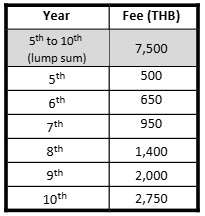
Once granted, a design can last for 10 years, provided that annuity fees are timely paid by the design owner. Annuity fees are due from the 5th year onwards, but only once the design has been granted. They can be paid as a lump sum or annually:
Licensing & assignment
During the validity period of the design patent, the design owner may license the exclusive rights derived from the patent to any third party, in exchange for the payment of royalties. The license agreement must be recorded at the DIP and specify the conditions, restrictions and royalty terms of the licensing.
The design owner may assign the design patent to any third party, even while the application is still pending.