TMP Tips
Design patent vs. trademark in Thailand: which one do you need?
Design patents and trademarks can be easily confused by the general public. At first glance, they may seem similar because both are forms of intellectual property, referring to intangible assets that result from human creativity. In reality, however, design patents and trademarks protect very different aspects and serve distinct purposes. Understanding these differences is essential to choosing the right type of protection for your products or brand. So, which one is appropriate for your needs?
Design patent in Thailand
A patent is a document issued to grant protection for an invention or a design. The law defines a design as any shape or composition of lines or colors that gives a special appearance to a product and can be applied to a product of industry or handicraft.[1] Its purpose is to protect the external appearance of a product, such as its shape, configuration, or the composition of lines or colors that give the product a distinctive character.
Examples of patentable designs relating to shape or configuration are bags, toys, cars, elements of furniture, jewelry, etc. Examples of designs relating to the composition of lines or colors are patterns on fabric or on kitchenware.
However, not every design is eligible for protection under Thai design patent law. To qualify, a design must be new, i.e. not having been used or made available to the public before and not be similar to an existing design.
A design can be protected for up to 10 years.
Trademark in Thailand
A trademark is a sign or word used on or in connection with goods or services, to distinguish these goods or services from those of other sellers or service providers. A trademark can be a drawing, word, phrase, combination of letters and/or numeral, a combination of colors, a shape, a sound, or a combination thereof.[2]
The main function of a trademark is to create a brand identity and help consumers recognize and clearly distinguish the goods and services from those of others. Therefore, to be registered, a trademark must be distinctive (not descriptive or generic) and must not be confusingly similar or identical to existing trademarks.
A trademark can be protected indefinitely, provided that renewal fees are paid every 10 years.
3D mark or design patent?
Following the basic understanding of design patent and trademark, it is clear how they differ in terms of legal protection. However, when it comes to 3D shapes, there may still be confusion as to whether they fall under the protection of a design patent or a 3D mark.
A 3D mark is a type of trademark that represents the shape of a product. 3D marks can be registered in Thailand since 2000. As per the Thai Department of Intellectual Property’s examination guidelines adopted shortly after,[3] an application for a 3D mark must clearly show width, length, depth, and overall dimensions. In practice, it is often used for product designs or product packaging.
The representation of a 3D mark and a design patent may appear similar. However, the key difference lies in the function of the shape. A 3D mark must not represent a functional shape that directly shows what the product is or how it works, as it is intended to be used in connection with goods or services for brand identification purposes. In contrast, a design patent can protect a functional shape, as long as the protection applies only to its appearance and not to its function, which should be protected by an invention patent.
The line between the two rights becomes blurred as several descriptive 3D marks, and standard 2D marks for descriptive container shapes, were allowed to be registered over the years. This is due to two exceptions under Thai trademark practice:
(1) The first one allows the registration of a visually descriptive trademark if it has become distinctive through use, i.e. if it has been used in Thailand to the extent that Thai consumers would identify the origin of the products easily.[4]
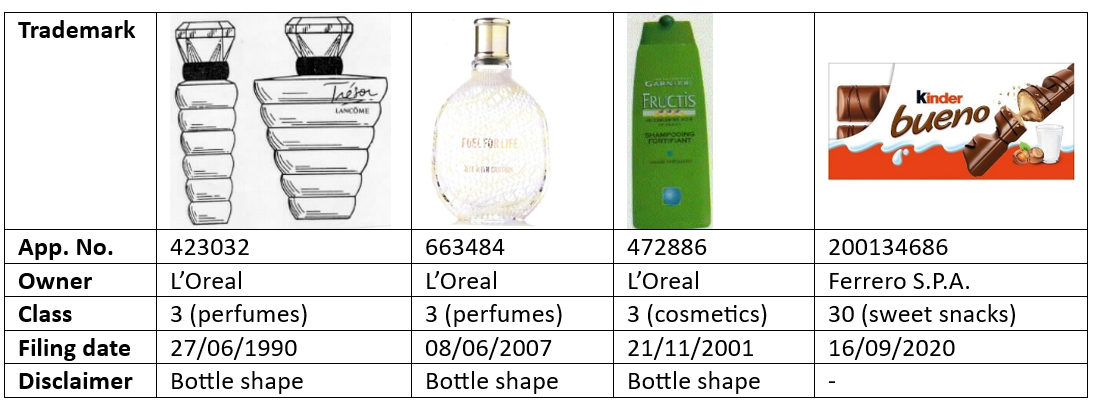
(2) The second exception relates to container shapes that are registered as trademarks not to be sold as packaging or containers (classes 20 and 21) but to sell the actual products they contain, e.g. a perfume bottle to sell perfume (class 3), a beverage bottle to sell beverages (classes 32 and 33), etc., providing the design of the packaging is customized.[5] However, in such cases, the generic packaging they represent (e.g. a bottle) should be disclaimed in the trademark application.
Case studies of iconic marks and designs in Thailand
To date, 3D marks are increasingly chosen by IP rights owners in Thailand, instead of or in combination with a design and/or a standard packaging (2D) mark.
(1) Beverage bottles: soft drinks and alcohol
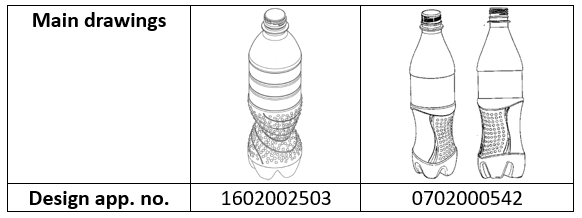
In Thailand, The Coca-Cola Company registered several designs for bottles as containers, including:
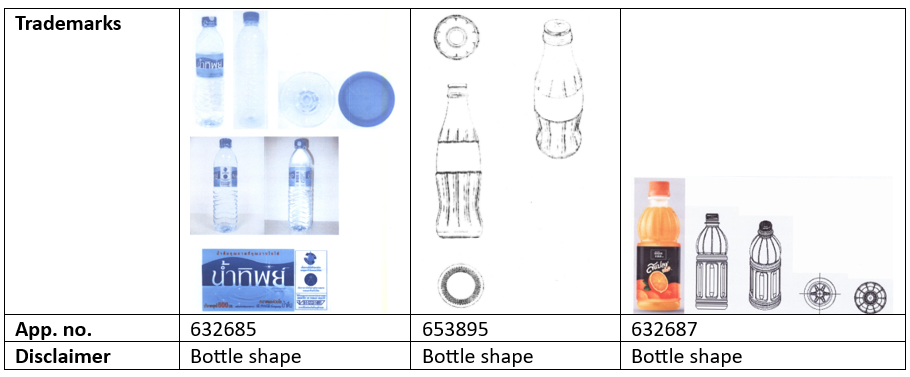
They also registered several 3D trademarks in class 32 (beverages) for bottle shapes, such as:
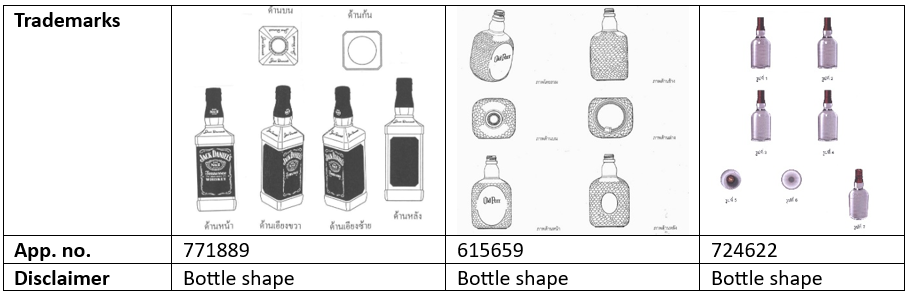
Other alcohol brands have obtained a 3D mark for the following bottle designs:
(2) Jewelry designs: the case of the “Alhambra®” by Van Cleef & Arpels
The iconic “Alhambra®” jewelry design from Van Cleef & Arpels was registered in class 14 as a 3D mark in Thailand in 2025 (under application no. 240143635):
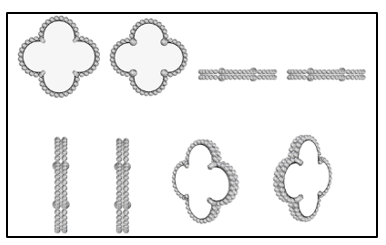
Considering that this jewelry shape was created in 1968, it was no longer eligible for design protection in Thailand. Obtaining rights over a 3D mark constitutes a major step to secure exclusive rights over the use and sales of this symbol for jewelry products.
(3) Fashion design: the case of the “Birkin bag” by Hermès
In Thailand, Hermès was able to secure a trademark (2D) in class 18 (handbags) for the design of their Birkin bag (under application no. 180135854):
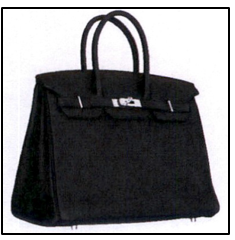
To overcome the descriptiveness objection, one can assume that the applicant provided sufficient evidence of use of this bag as a trademark in Thailand to demonstrate that it had acquired distinctiveness through use.
(4) Other packaging shapes registered as trademarks (2D)
Below are a few examples of successful trademark registration for packaging shapes in Thailand:
Key differences between design patent and trademark
If we set aside the two exceptions discussed previously, a design patent and a trademark have key differences. To help make the right decision, if you need to protect the appearance of a product, such as its shape, configuration, or the composition of lines or colors, you should choose a design patent. On the other hand, if you need to protect a sign or shape used with goods or services to represent your brand and distinguish your products from those of others, you should choose a trademark.

In some cases, for works of art, such as applied art or a drawing used as a device mark, copyright protection may also apply.
How to choose the right protection

In summary, choosing the appropriate type of protection depends on whether you wish to protect the design of your product, the brand identity, or both. While a design patent protects the external appearance and may include functional shapes, a trademark, particularly a 3D mark, protects distinctive, non-functional shapes that identify the source of goods or services.
References:
[1] Patent Act B.E. 2522 (1979).
[2] Trademark Act B.E. 2534, Section 7.
[3] Thai Department of Intellectual Property, Criteria and Procedures for Registration of Trademarks in the Form of Shapes or Configurations of Objects (2002).
[4] Trademark Act B.E. 2534, Section 7.
[5] This line of practice can be illustrated by the Supreme Court decision, Coca-Cola Company v. Department of Intellectual Property, Case No. 7024/2549 (2006). However, the Trademark Board is reluctant to give way to this exception, for instance for recent applications nos. 170132188, 180144119, 180141051 and 180131531, with stringent requirements regarding the customization of the packaging.