TMP Tips
Trademark renewal in Thailand
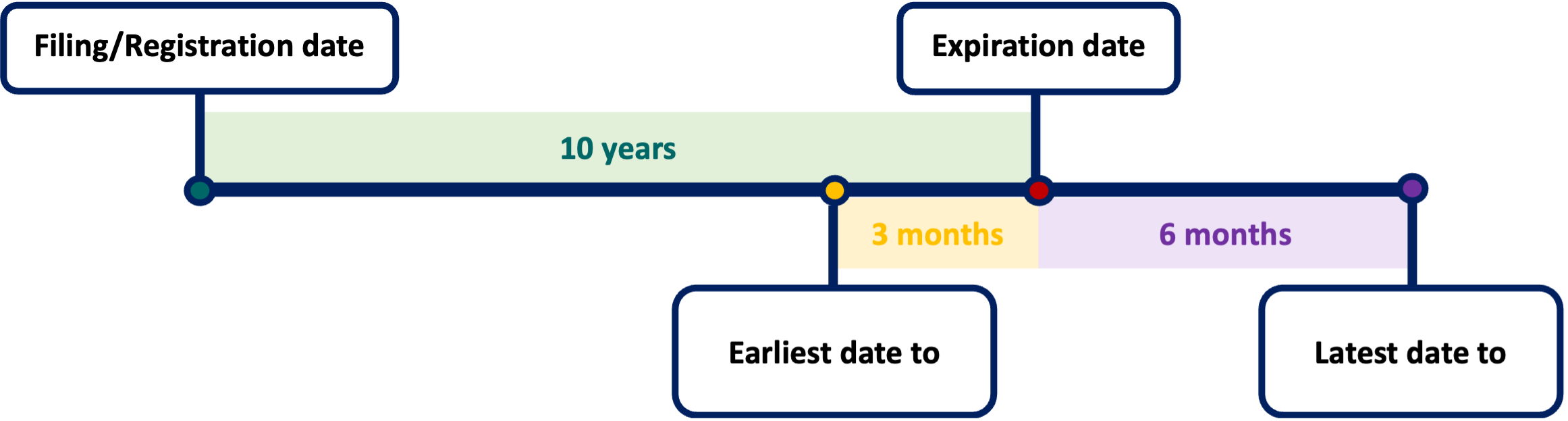
In Thailand, upon registration, a trademark is protected for a term of 10 years from the filing date, pursuant to Section 53 of the Trademark Act B.E. 2534 (1991). Thereafter, the registration may be renewed indefinitely for successive ten-year periods. Under Section 54 of the Trademark Act, renewal may be effected by filing a renewal application and paying the prescribed official fees within 3 months prior to the expiration date. The renewal application must be filed with the Thai Department of Intellectual Property (DIP).
Pursuant to Section 42 of the Trademark Act, a trademark registration is deemed effective from the filing date of the application rather than the registration date or the date on which the trademark application is approved for registration. Accordingly, the term of protection and the corresponding expiration date are calculated from the application filing date. As a result, the renewal due date is determined by counting 10 years from the filing date of the trademark application.
1. Filing of trademark renewal applications
The renewal application may be filed either electronically through the DIP e-filing system or in person with the DIP using Form Kor.07 (trademark renewal application). The official renewal fees are calculated based on the number of goods or services covered by the registration :
– For 1 to 5 items: THB 2,000 per item;
– For more than 5 items: THB 18,000 per class.
At the time of renewal, the applicant may consider restricting the list of goods or services if the trademark is no longer being used in relation to certain items covered by the registration. Limiting the specification may help avoid unnecessary renewal costs for goods or services that are no longer commercially relevant to the trademark owner.
It should be noted that additional official fees may be imposed if any goods or services have been reclassified under the current classification practice of the DIP. In such circumstances, the applicant may choose to delete the reclassified items by filing an explanation letter confirming that protection is no longer required for those items. No official fee is required to be paid for filing such a letter.
The renewal process generally takes approximately 3 to 6 months from the filing date. Upon completion of the renewal process, the DIP will issue a new certificate of registration confirming the continued validity of the trademark registration.
2. Fast-track renewals
According to the DIP Announcement issued in 2021, trademark renewals may be processed under a fast-track procedure. To benefit from such procedure, the renewal application must be filed in person at the DIP, and the applicant must expressly notify the officer of their intention to proceed under the fast-track system.
The conditions for fast-track renewal are as follows:
(1) the trademark registration must cover no more than 30 items of goods or services; and
(2) no amendment may be made in connection with the renewal application, including changes to the applicant’s address, appointment of a new agent, or deletion of goods or services.
Where the above conditions are fully satisfied, the renewal application will be approved on the filing date. The DIP will subsequently issue the new certificate of registration on the same day, allowing the applicant to obtain the renewed registration certificate without undergoing the normal renewal examination period.
3. Late renewals
Should the owner of a trademark fail to renew the registration before the expiry date, the trademark will not be deemed abandoned immediately. If the owner still wishes to maintain protection for the trademark, a late renewal application may be filed pursuant to paragraph 2 of Section 54 of the Trademark Act. The late renewal application must be submitted within 6 months from the expiration date of the registration and will be subject to a surcharge equivalent to 20% of the applicable official renewal fees.
If the trademark is not renewed within the six-month grace period, the registration will be deemed abandoned. No restoration procedure for abandoned trademarks is available in Thailand. In case the owner still requires protection, they may file a new trademark application, which will be subject to examination and approval by the Thai DIP similarly to a new application.
In certain cases, the registration process for a trademark application may extend beyond 10 years from the filing date, resulting in the expiration of the renewal grace period before registration is completed. This may occur for cases where appeals have been filed with the Trademark Board, as the consideration time for administrative appeals may extend beyond six years (at the time of drafting this article), and may be followed by further litigation before the courts. If the application subsequently proceeds to registration, the DIP will issue a notice requesting payment of the renewal fee. In such circumstances, the 20% surcharge for late renewal will not apply.
4. Possible extension of protection
In Thailand, the Trademark Act states that a trademark registration is protected for a term of 10 years, and such protection will be terminated if the trademark is not renewed within the six-month grace period. However, in practice, the protection of a trademark, or the rights attached to an expired trademark, may in certain circumstances be considered to continue even though the registration has lapsed and the trademark is shown as abandoned in the DIP database, provided that the trademark has been continuously used.
Example: Matsuda Trademarks
Two trademarks for the word “Matsuda” (in different stylized forms) were registered for glasses-related goods in Class 9. One was owned by a Japanese company, while the other was owned by a Thai individual. The trademark registration owned by the Thai individual, which had been filed in 2001, expired in 2021 due to the owner’s failure to file a renewal within the prescribed timeline. The Thai individual subsequently re-filed their trademark application in July 2022.
The re-filed application was objected by the registrar on the grounds that it was considered similar to a prior trademark application owned by the Japanese company, which had been filed in March 2022. In response, the Thai applicant filed an appeal before the Trademark Board, arguing that special circumstances existed and that the trademark should therefore be registrable under Section 27 of the Trademark Act.
In considering the appeal, the Trademark Board reviewed the evidence of use submitted by the applicant and initially determined that the trademark could proceed to registration under special circumstances. The Board took into account that the applicant’s previous registration had expired only 11 months prior to the filing of the new application, and that sufficient evidence had been provided to demonstrate continuous use of the trademark.
The Japanese owner was subsequently notified by the DIP of the Trademark Board’s initial decision; however, since no objection was raised, the Trademark Board issued its final decision allowing the new trademark application filed by the Thai individual to proceed to registration, thereby permitting the coexistence of the “Matsuda” trademarks.
Unlike certain countries, Thailand does not require trademark owners to submit a declaration of use of the mark in order to maintain a trademark registration. However, evidence of use may be helpful in situations such as this, or where a trademark is subject to a cancellation on the grounds of non-use.
5. Changes in owner details
In the event of any changes to the owner details, be it a change of name or address, such updates may be recorded with the DIP at the time of filing the renewal application.
If the ownership of the trademark has changed, the assignment may also be recorded with the DIP simultaneously with the renewal application.
Upon completion of the recordal of the changes and the renewal, a new certificate will be issued in the name of the current owner.
6. Renewal of Madrid applications
The renewal of an international trademark registration designating Thailand may be carried out directly through the WIPO online system. International registration remains valid for a period of 10 years from the date of international registration and may be renewed for successive ten-year periods.
The renewal request may be filed within 6 months prior to the expiration date. The renewal fees are calculated based on the basic fee of CHF 653, together with the fees applicable to each designated country and the number of classes covered. The renewal fee per class for Thailand is CHF 450, which is equivalent to the fee charge for trademarks filed via the domestic route, provided that more than 5 items have been listed in a class.
A six-month grace period is also available following the expiration date, subject to payment of a surcharge equivalent to 50% of the basic renewal fee. Failure to renew the registration within the grace period will result in the international registration ceasing to have effect in the designated jurisdictions.
Conclusion
The request for renewal of a Thai trademark registration may be filed with the Thai Department of Intellectual Property (DIP) within 3 months prior to the expiration date of the registration. If the renewal is not filed within such period, the trademark will remain valid during the 6-month grace period following the expiration date, within which the renewal may still be filed. Failing this, the trademark will be deemed abandoned and the registration will lapse.
In general, the official fees for renewal are calculated based on the number of goods and services covered by the registration. Additional official fees may also apply if further amendments are required during the renewal process, such as changes of list of goods or services, owner’s name, address, or agent.
The DIP generally takes approximately 3 to 6 months to process the renewal application and issue the renewed trademark certificate.
References:
[1] Department of Intellectual Property