Insight
Cancellation of trademarks for non-use in Thailand
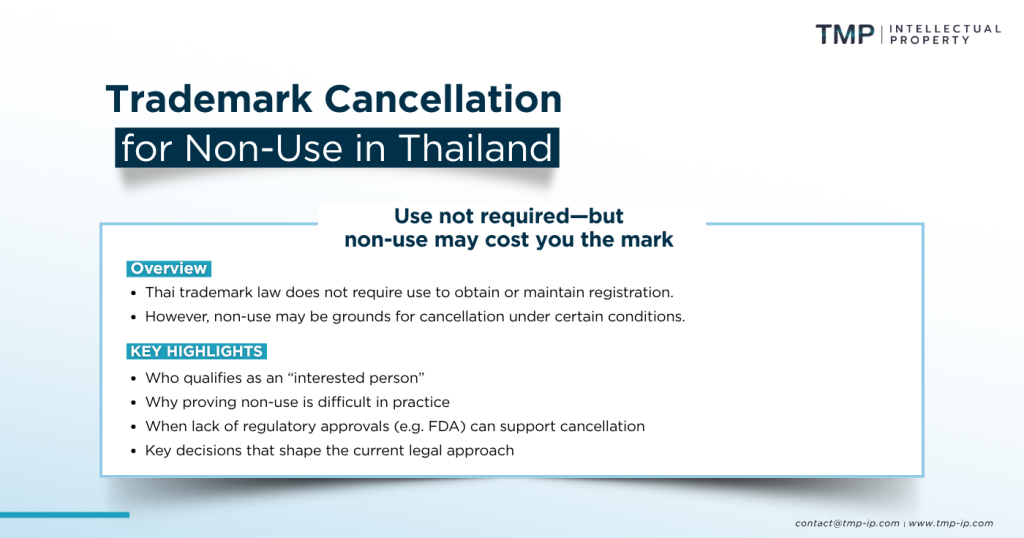
In Thailand, use of a trademark is not a requirement neither for obtaining trademark registration nor for maintaining a trademark registered, unlike in a few other countries. Nevertheless, non-use can be a reason to revoke a registered trademark. There is a process for trademark cancellation that allows any interested person or the registrar to request a cancellation of a registered trademark on the ground that the trademark has not been genuinely used in commerce.
The spirit of this provision is primarily to prevent a person or business from registering a trademark with the mere intention of barring competitors, instead of using the mark in commerce as a badge of origin of its products or services. Such practice, so-called “stockpiling”, could give rise to unused defensive trademarks that can impede fair competition.
Legal provisions governing non-use cancellation petitions
Non-use trademark cancellation actions are covered in Section 63 of the Thai Trademark Act. The statute provides that:
“Any interested person or the Registrar may petition the Board to cancel a trademark registration if it is proved that at the time of registration the owner of the trademark had no bona fide intention to use the trademark with the goods for which it was registered and in fact there was no bona fide use whatsoever of the trademark for such goods or that during the three years prior to the petition for cancellation there was no bona fide use of the trademark for the goods for which it was registered unless the owner can prove that such non-use was due to special circumstances in the trade and not to an intention not to use or to abandon the trademark for the goods for which it was registered.”
In light of the foregoing provision, in order to succeed in a trademark cancellation request, the petitioner bears a two-fold burden of proof. The first of is to prove that they are an “interested person” in requesting the cancellation of the disputed trademark; the second is to prove the non-use of the trademark by its owner or by another person subject to the owner’s control.
As for the second requirement (proving non-use of the mark), Section 63 establishes two categories:
(I) The owner never had the intention to use the trademark, which has not been used since it was registered
This first category requires the petitioner to produce evidence to the Trademark Board proving that:
(a) The trademark owner did not have a genuine intention to use the trademark with the registered goods or services when they registered the mark; and that
(b) There was no legitimate use of the trademark with the connected goods or services.
(II) The trademark has not been used within the past three years
While the specific duration of non-use is not specified in the first category, the latter category, on the other hand, requires the petitioner to demonstrate that the mark was not used within the three years prior to filing the cancellation petition. In defense, the trademark owner can argue that the lack of use was justified by “special circumstances in the trade“, such as economic recession, resource scarcity, or government regulations, and that the non-use did not stem from an “intention not to use or to abandon” the trademark.
Under the first category, it could prove difficult to establish the bad faith of the trademark owner at the time of registration, while under the second category, the owner of the mark could easily raise a defense on the ground of special circumstances in the trade.
The interpretation of “interested person” in jurisprudence
The Supreme Court, in its Decision No. 6220/2561, interpreted that an interested person should have a connection with the trademark that they seek to cancel. In the instant case, the Court determined that the plaintiff qualified as an interested person under Section 63 considering the plaintiff’s prior use and ownership of the trademark outside of Thailand, which occurred before the defendant filed their trademark application and began publicizing the mark on their website.
In the Decision No. 51/2564, the Board of Trademark adhered very strictly to this legal precedent. In this case, the petitioner’s trademark was objected for similarity to the defendant’s trademark. To overcome the similarity objection, the petitioner deleted the conflicting class and simultaneously filed for the cancellation of the defendant’s mark on the basis of non-use. However, the Trademark Board considered that by deleting the conflicting class, the petitioner no longer qualified as an “interested person” under Section 63 and thus rejected the petition.
The interpretation of “use” by the Trademark Board
While in theory there seems to be two non-use cancellation options, in practice, the Trademark Board, supported by the IP&IT Court, has cumulated the conditions of the two categories, which means that:
(1) It would not be possible to file a non-use cancellation without giving sufficient time to the trademark owner to use the trademark, which we would assume would be at least three years from the registration date.
(2) Even if the trademark has not been used for three consecutive years, the petitioner should also demonstrate that the owner of the mark does not have the genuine intention to use it.
In respect of this last point, the Trademark Board laid down a principle that once the trademark has been registered, it shall be presumed that its owner has the intention to use it. This strict evidentiary standard employed by the Trademark Board makes successful cases based on the ground of non-use relatively uncommon in Thailand.
A few examples of the Trademark Board’s decisions on trademark cancellation petitions based on the ground of non-use provide further insight on this matter.
– Inadequacy of market survey reports
In the Decision No. 30/2543, the petitioner’s application for registration of “WALPAMUR” trademark was rejected on the ground that the trademark had already been registered. The unsuccessful applicant thus filed a petition for non-use against the prior registered trademark. They produced a market survey report as evidence showing the non-use of the trademark for a duration of three years. Even though no argument was made by the registrant in response to the petitioner’s claim, the Board held that the market survey report was insufficient to prove that the registrant had no intention to use the trademark.
The Trademark Board’s Decision No. 44/2556 reflected similar consideration, as it was held that a market survey report prepared by an independent investigator which demonstrated the non-use of the trademark in Thailand was not adequate to prove that the registrant had no intention of using the mark. In this case, the trademark owner also did not submit any argument in response to the petition to cancel the trademark.
The foregoing decisions reflect that it is undeniably uncommon for a cancellation petition to be positively considered by the Trademark Board. While proving non-use for the required period is already challenging, it is even more burdensome for the petitioner to rebut the presumption of the trademark owner’s intention to use the trademark. These legal provisions and the Board’s strict evidentiary standard lead to dismissal of well-founded petitions, even in cases where no defenses from the trademark owner are submitted for consideration.
– Relative admissibility of lack of proper government permits or approvals
In Trademark Board’s Decision No. 13/2555, the petitioner filed a petition to cancel a service mark claiming that the owner had never been granted a license from the Department of Health Service Support in order to provide the health services designated under the mark. To support their claim, the petitioner produced evidence from the Department of Health Service Support’s website proving the owner’s lack of permit and also evidence retrieved from the website showing that they were not conducting business in Thailand. The trademark owner did not submit any defense against the petitioner’s claim. The Board, after consideration of the supporting evidence, held that the evidence in the form of a printout from a website had no value as it had not been verified and that it was not compulsory for health service-related businesses to obtain a license to provide their services in Thailand. Therefore, the evidence was deemed insufficient to prove that the registrant had no intention of using the trademark.
One landmark decision that merits consideration is the Trademark Board’s Decision No. 14/2550. In this case, a cancellation petition was filed against the trademark “KARAMUCHO” registered for food-related goods such as potato chips and other snacks. The petitioner submitted a letter from the Thai Food and Drug Administration (FDA) to the Board, stating that the trademark owner had never obtained any FDA approval to sell these goods in Thailand, which could thus never have been sold legally on the Thai market. In this case, the Board held that the lack of FDA registration was sufficient to prove that the trademark owner did not use and had no intention of using the trademark and proceeded to revoke the registration of the mark.
The different outcome of this last case can be attributed to the nature of the products bearing the disputed mark – potato chips and other snacks, for which registration is a prerequisite to offering them for sales in Thailand.
Conclusion
According to the legal provisions and the line of decisions from the Trademark Board discussed above, a concise summary of the trademark non-use cancellation practice in Thailand could be drawn as follows: even if cancellations of registered trademarks have been uncommon, there is still a chance of success.
A minima, it can be inferred from the Board’s Decision No. 14/2550 that in cases where an official registration or a regulatory approval is a prerequisite for sales of products, the absence of such registration or approval could be sufficient to prove both the non-use and the lack of intention to use the mark.
References:
(1) Chaikasetsin, S. (2017). Legal Issues regarding Cancellation of Trademark. [Master’s independent study, Ramkhamhaeng University].
(2) Nakarat, J. (2016). Non-use Cancellation against Trademark Registration in Thailand. Thammasat Business Law Journal, 6, 89-103.
(3) Phillips, J. & Simon, I. (2005) Trade Mark Use. (1st ed.). Oxford University Press.
(4) Panyarat, P. (2022). Problems concerning Revocation of Trade Marks in case of Non-use of Marks [Master’s independent study, Thammasat University].
(5) Coca-Cola Company v. Department of Intellectual Property, Case No. 6220/2561 (2018).