TMP Tips
Thailand trademark opposition: how to challenge a conflicting mark
In Thailand, after a trademark application is filed with the Department of Intellectual Property (DIP), the application is examined by the Registrar. If the Registrar considers that the trademark is registrable, the application will be published to allow any person to oppose the registration.
Under Section 35 of the Trademark Act B.E. 2534 (1991), any person may file an opposition on specific statutory grounds (see section 3 below), such as where they have better rights in the trademark than the applicant. A trademark opposition therefore allows a person to challenge a trademark application before it is registered. It must be filed within 60 days from the date of publication of the trademark application. If no opposition is filed within the publication period, the application may proceed to registration upon payment of the corresponding registration fees.
1. Trademark watching in Thailand: how to avoid missing the opposition deadline
In Thailand, a trademark opposition must be filed within 60 days from the date on which the trademark application is published. This deadline runs from the date of publication, rather than from the date on which the potential opponent becomes aware of the application.
Missing this deadline means losing the opportunity to oppose the application. A person who wishes to protect their trademarks against confusingly similar new marks should therefore monitor trademark publications regularly to identify potentially conflicting marks and ensure that any opposition is filed within the acceptable timeline.
Trademark owners can check newly published trademarks by conducting regular trademark watches. This can be done by searching for identical or similar trademarks in the Thai DIP database or by reviewing the Thai Trademark Gazette, which is updated weekly. The relevant links are provided below:
– Thai DIP trademark database: https://tm-imagesearch.ipthailand.go.th/#/
– Thai Trademark Gazette: https://tmpub.ipthailand.go.th/en/
Alternatively, intellectual property law firms and specialized service providers offer trademark watch services. These services may be particularly useful for trademark owners managing large trademark portfolios.
2. Possible grounds for opposing a trademark in Thailand
Under Section 35 of the Trademark Act, the possible grounds for a trademark opposition in Thailand are as follows:
(1) Better rights than the applicant: An opponent may claim that it has better rights in the trademark than the applicant, such as where the opponent has prior rights arising from earlier use (in Thailand or overseas) of the mark.
(2) Failure to meet the requirements for registration under Section 6: A trademark may be opposed where it is not registrable under the Act, including where it lacks distinctiveness, falls within a category of prohibited marks, or is identical or confusingly similar to an earlier registered trademark. Protection for well-known marks may also be relevant for marks with an established reputation.
(3) Non-compliance with the Trademark Act: An opposition may also be based on other statutory requirements where the application does not comply with the provisions of the Act.
The appropriate grounds will depend on the circumstances of each case, and the evidence needed to support them are described below.
3. Initiating a trademark opposition in Thailand: required documents
To oppose a trademark, the opponent must file an opposition with the DIP using Form Kor.02. The opposition may be filed through the DIP’s e-filing system or in person at the DIP office. The official fee is THB 2,000 per opposed application.
In the opposition claims attached to Form Kor.02, the opponent must state the grounds of opposition and provide supporting evidence to substantiate those grounds. Evidence may include trademark registration certificates, dated sales invoices and purchase orders bearing the mark, product packaging or labels, advertising and marketing materials, and online materials with verifiable dates, such as social media accounts, pages and posts, e-commerce listings and domain registration records. Where appropriate, evidence showing the nature and extent of use of the earlier mark may also help establish the opponent’s position, reputation and good faith, particularly where the opposition relies on prior rights or use. Where the opponent relies on prior use or prior rights, such evidence should generally predate the filing date of the opposed application, and it should be sufficiently clear to demonstrate the connection between the opponent, the mark, and the relevant goods or services.
If the opposition is filed through a representative, it is also mandatory to provide a notarized Power of Attorney within 15 days from the filing date of the opposition. Evidence of use must be submitted within 60 days from the filing date of the opposition.
4. Practical advice to prepare for an opposition: the opponent’s perspective
Because the opposition period is short and cannot be extended, preparation should begin as soon as a conflicting application is identified. The following steps can help the opponent make the best use of the available time:
(1) Confirm the details of the published application: Record the application number, the publication date, the applicant, the goods or services, and the class, and calculate the final filing date immediately so that the deadline is calendared before any other work starts.
(2) Compare the marks and the goods or services: Assess the marks visually, phonetically, and in meaning, and consider whether the goods or services overlap or are likely to be associated by consumers.
(3) Collect evidence early: Registration certificates, dated invoices, packaging, and verifiable online records are easier to gather before the deadline approaches, and evidence of use is easier to follow when it is organized chronologically.
(4) Prepare the representative’s documents in advance: Where a representative will file the opposition, arrange the notarized Power of Attorney as early as possible, since notarization can take time, particularly for foreign opponents.
(5) Consider the commercial objective: Opposition is not always the only route: a negotiated outcome, such as a coexistence agreement or a limitation of the goods covered by the application, may serve the opponent’s business interests better than a contested proceeding that may span several stages.
5. Trademark opposition process: timeline and steps
TRADEMARK OPPOSITION PROCESS – FLOWCHART
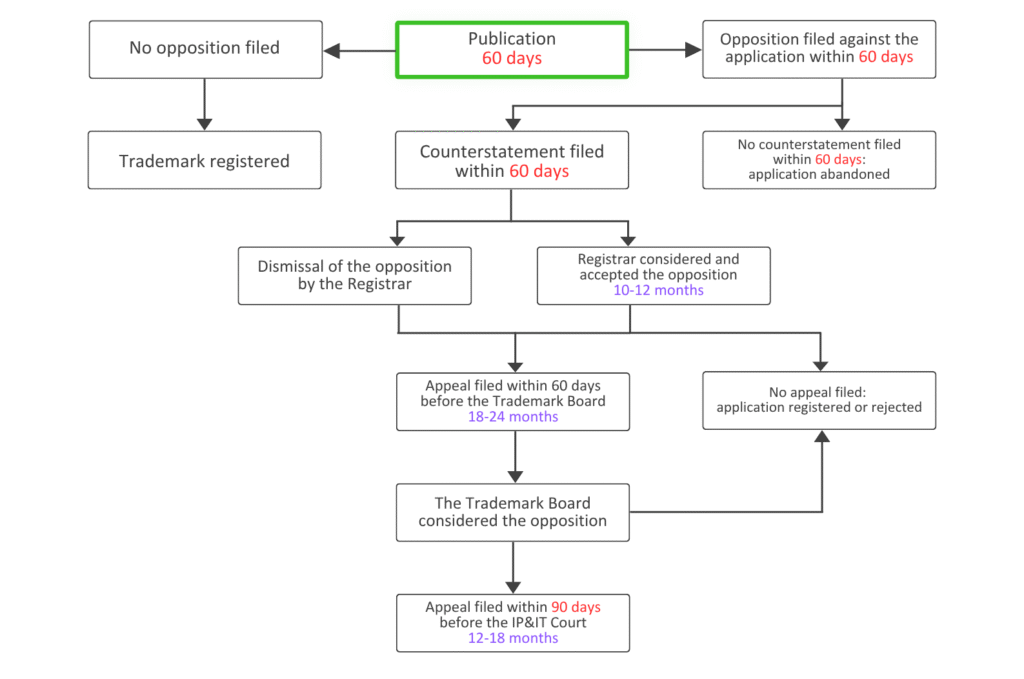
Once an opposition has been filed, a copy is sent to the applicant by the Registrar. The applicant must then file a counterstatement addressed to the Registrar within 60 days from the date of receipt of the opposition, and a copy is subsequently provided to the opponent. If the applicant fails to file a counterstatement within the prescribed period, the application will be deemed abandoned.
In considering the opposition, the Registrar may require the applicant or opponent to provide additional statements, explanations, or evidence. If a party fails to comply with such an order within 60 days, the opposition will be considered based on the evidence already available.
After considering the opposition, counterstatement, and evidence submitted by the parties, a decision will be issued. In practice, the consideration of a trademark opposition at this stage may take approximately 10 to 12 months, although the actual timeframe may vary.
The Registrar may either allow the application to proceed to registration or refuse the application based on the opposition. The applicant or opponent may appeal the Registrar’s decision to the Trademark Board within 60 days from the date of receipt of the notification of the decision. The official fee for filing such an appeal is THB 4,000. The Board typically takes around 18 to 24 months to decide an appeal for opposition cases.
Either party may then appeal the Trademark Board’s decision before the Central Intellectual Property and International Trade Court (IP&IT Court) within 90 days from the date of receipt of the Board’s decision. The process before the IP&IT Court usually takes around 12 to 18 months.
If no appeal is filed within the applicable periods, the relevant decision will become final.
6. Defending against an opposition: the applicant’s perspective
For domestic applications, the Registrar will send the opposition to the applicant or their representative by post, which allows the DIP to fix the date of receipt from which the 60-day period runs. If delivery fails, the DIP may resend the opposition to the office or address given in the application. If the second delivery cannot be made directly to the intended recipient, it may be delivered to any person at that address or posted in a conspicuous place at the address. The opposition will be deemed to have been received on the day after the first delivery if it succeeds, or 7 days after the second attempt if the first failed. Keeping updated contact details on the trademark application is hence essential, as otherwise the applicant may not be informed at all that an opposition was lodged.
The applicant may file the counterstatement on their own. Given the legal nature of the proceedings, however, it is preferable to be assisted by a lawyer specializing in intellectual property. The counterstatement should address the grounds relied upon in the opposition and set out the reasons and evidence supporting the applicant’s position, including relevant case law where available.
7. Trademark opposition to a Madrid application: procedural differences
Where the opposed trademark is an international registration designating Thailand under the Madrid Protocol, additional procedural requirements apply.
Under Clause 22 of the Ministerial Regulations on the Registration of Marks under the Madrid Protocol B.E. 2560 (2017), where the Thai designation is opposed, the Registrar will issue a notice of refusal based on the opposition and notify the International Bureau of the refusal together with details of the opposition. The applicant must appoint a Thai agent, who must file the counterstatement within 60 days from the presumed receipt date of the opposition notice. The appointment will require a notarized Power of Attorney. Under Clause 33 of those Regulations, the applicant is deemed to have received the Registrar’s notice 30 days after the date on which the Registrar issues the notice.
Where the Thai designation of the international registration already has a Thai agent, that agent will receive the opposition by postal delivery and can handle the opposition proceedings in Thailand, including timely filing of the counterstatement.
8. Trademark opposition vs. trademark cancellation
Once the opposition period has passed, a pending application can no longer be challenged through the opposition procedure. However, the Trademark Act provides separate procedures for the cancellation of a registered trademark (Sections 61–67).
Under these provisions, a petition may be filed before the Trademark Board to cancel a registration, either by an interested party or the registrar, as the case may be, including where the trademark has not been used in good faith or has not been used for the registered goods during the three years preceding the cancellation petition, subject to the statutory requirements.
Trademark opposition and cancellation serve different purposes and apply at different stages of the registration process. An opposition is available while a trademark application is pending, whereas cancellation concerns a trademark that has already been registered. If the opposition deadline has passed, the availability of cancellation or other legal remedies will depend on the circumstances and the applicable statutory grounds. Accordingly, cancellation should not be viewed as an automatic substitute for an opposition.
The opposition and cancellation procedures may also be pursued one after the other: a party whose opposition was unsuccessful may still file a cancellation request once the trademark is registered.
Conclusion
A trademark opposition provides a critical legal mechanism for challenging a conflicting trademark application before the mark is registered in Thailand. To succeed, the opponent should clearly state the grounds of opposition and support them with evidence.
The main time limits in the opposition process are summarized in the table below.
Step | Time limit | Counted from |
|---|---|---|
Opposition | 60 days | Date of publication of the application |
Power of Attorney | 15 days | Filing date of the opposition or counterstatement |
Evidence of use | 60 days | Filing date of the opposition or counterstatement |
Counterstatement | 60 days | Receipt of the opposition (for Madrid applications, deemed receipt of the Registrar’s notice, 30 days after it is issued) |
Appeal to the Trademark Board | 60 days | Receipt of the Registrar’s decision |
Appeal to the IP&IT Court | 90 days | Receipt of the Trademark Board’s decision |
Monitoring trademark publications is therefore important to identify conflicting marks and take timely action. Where the opposed mark is a Madrid application designating Thailand, additional requirements concerning Thai representation and the Madrid notification procedure should also be considered.
References:
[1] Department of Intellectual Property